Passport For Good: Ed-tech legacy software redesign
-
UX and content design for an ed-tech software that tracks community service and engagement hours for K-12 students.
My role - Design, information architecture
Scope - 1.5 years
Stakeholders - Product Management, Development, Customer Support, Sales
-
Students in middle and high school are engaged in lots of activities outside of the classroom: clubs, after-school programs, community service, internships, etc.
The existing solution for keeping track of these activities and hours involves piles of paperwork, which needs to be manually verified and approved by external event supervisors and school staff. This adds hours of work to already overloaded teachers and school admin, and makes it difficult to keep track of ongoing progress and catch gaps in student engagement.
Passport For Good was designed nearly a decade ago to address this challenge, but the software was out of date and needed a major redesign to stay current with student and staff needs.
-
As the sole designer for this software redesign, my priority was working in an agile environment to develop design requirements with product development, iterate on designs, and hand them off to development — often within weeks. Working with such a small team meant that roles often overlapped, and I was often involved in the decisions of product planning, as well as working closely with development to come up with creative solutions to balance multiple design priorities.
This project was concurrent with 3-4 other consulting projects, so my design strategy focused on “lean” design to keep specifications simple and minimize developer overhead.
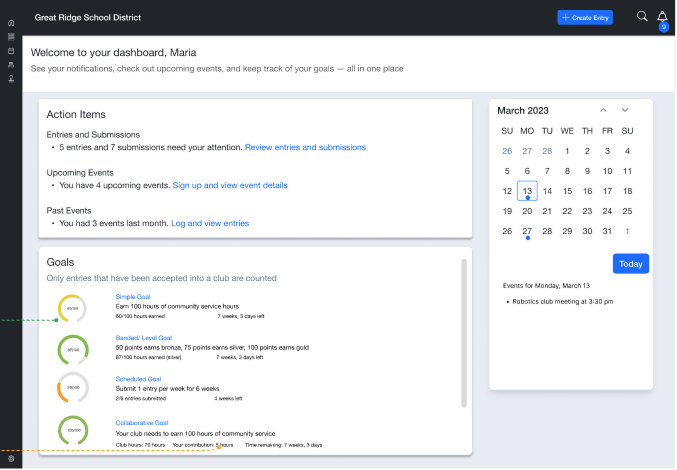
I prioritized big-picture software needs: for students to create their hours and submit them, and for staff to approve hours and add them to existing school goals. Beyond that, I focused on practical design, streamlined information architecture, and building customer support into the product. This last point involved artifacts like information bubbles, clear page headers, an easily-navigable menu bar, and other items designed to decrease customer support requests for basic product information.
My work included design critiques and strategy sessions with the product owner, developers, and sales team.
-
Passport For Good is Superluminal’s flagship product, and getting the redesign right was critical to supporting the company’s growth.
This project was my first time working on a project as a sole designer and owning responsibility for the end-to-end process, from product ideation to sales collaboration.
The biggest challenge was balancing the needs of student and staff users (a quick and easy way to log, track, and approve hours) with the complex back-end requirements of school integration system data (sensitive student data, multiple schools/ district, a variety of staff roles and permission levels).
This project exposed me to the complexity of redesigning a legacy product with an existing user base that included K-12 students. Balancing aggressive project timelines with limited developer allocation taught me to design as simply as possibly, not just for the final product users, but also for the intermediate product users of my Figma designs — the developers who had to build them.
Ultimately, the redesign was intended to streamline the users’ experience with the platform and increase product sales. Initial customer feedback has been overwhelmingly positive, who say that they are thrilled to have simplified dashboards and easier user flows for completing their work tasks quickly and efficiently.